
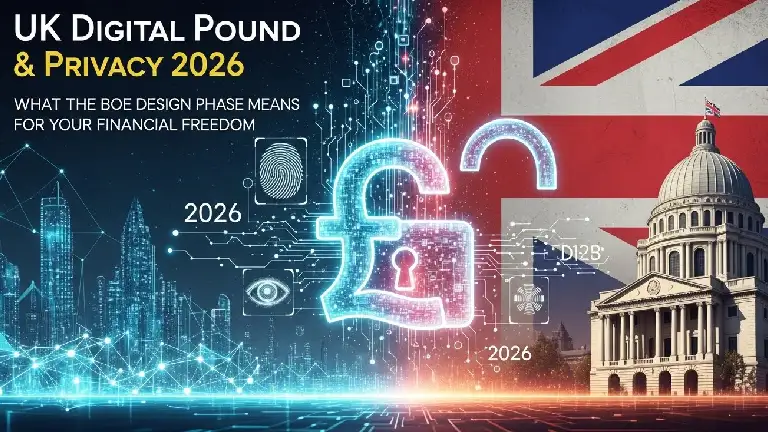
As we move into the final days of 2025, the conversation surrounding the future of money in the United Kingdom has shifted from “if” to “when.” On December 29, 2025, the Bank of England is deep into its critical “Design Phase” for what the media has dubbed “Britcoin.” For the readers of The Daley Trade, this isn’t just a technological update; it is a fundamental shift in how we understand UK Digital Pound & Privacy 2026.
The promise of a Central Bank Digital Currency (CBDC) is efficiency: instant settlements, lower transaction fees, and a modernized economy. However, for the sovereign trader, the core concern remains the UK Digital Pound & Privacy 2026. How much will the state see? Can your spending be programmed? In this deep dive, we break down the current 2026 blueprint and what it means for your financial boundaries.
The 2026 Design Phase: Understanding the UK Digital Pound & Privacy 2026 Blueprint
The Bank of England and HM Treasury have spent the last year conducting “hands-on experimentation” through the newly launched Digital Pound Lab. Our analysis of the UK Digital Pound & Privacy 2026 suggests that the government is attempting a “Platform Model.” In this model, the Bank of England provides the core infrastructure, while private companies (Payment Interface Providers) manage the user-facing wallets.
While the government claims that the UK Digital Pound & Privacy 2026 will be “private but not anonymous,” this distinction is where the risk lies. Unlike physical cash, every single unit of a digital pound is traceable. Our UK Digital Pound & Privacy 2026 research indicates that while the Bank of England itself may not see your name, the private wallet provider definitely will—and they will be legally required to share that data with law enforcement under the same AML (Anti-Money Laundering) rules that govern banks today.
1. The Programmability Trap
One of the most debated aspects of the UK Digital Pound & Privacy 2026 is “programmability.” Will the government be able to put an “expiry date” on your money or restrict what you can buy? The BoE has stated they will not program the money themselves, but they will allow private companies to offer “smart contract” features. From a UK Digital Pound & Privacy 2026 perspective, this creates a loophole where your financial freedom could be restricted by the terms and conditions of your wallet provider.
2. Tiered Privacy and Data Collection
We expect to see a tiered system for the UK Digital Pound & Privacy 2026. Low-value transactions (under £50) might require less data, but larger transfers will likely require full “Digital ID” integration. This link between your money and your digital identity is the biggest hurdle for UK Digital Pound & Privacy 2026. In a world of increasing cyber-attacks, a centralized database of your entire spending history is a massive target.
Why Investors are Flocking to Hard Assets: The UK Digital Pound & Privacy 2026 Effect
The rise of the UK Digital Pound & Privacy 2026 is actually one of the primary drivers behind the current Gold and Silver breakout. As we discussed in our previous articles on the Silver Vault Depletion 2026, investors are looking for “Exit Ramps” out of the digital surveillance system.
When you hold physical silver at $79 an ounce, you hold an asset that is outside the ledger of the UK Digital Pound & Privacy 2026. It cannot be turned off, it cannot be tracked via a “Digital ID,” and it cannot be “depreciated” by a central bank algorithm. The more the government pushes for the UK Digital Pound & Privacy 2026, the higher the “Privacy Premium” on gold, silver, and decentralized cryptocurrencies like Bitcoin will go.
The “Britcoin” Timeline: What Happens in 2026?
According to the latest roadmap, 2026 will be the year of “Primary Legislation.” This means the UK Parliament will vote on the legal framework for the UK Digital Pound & Privacy 2026. At The Daley Trade, we are monitoring these sessions closely. The key battlegrounds for UK Digital Pound & Privacy 2026 will be:
- Holding Limits: Rumours suggest a limit of £10,000 to £20,000 per person to prevent a “bank run” from traditional accounts into the UK Digital Pound & Privacy 2026.
- Offline Payments: The BoE is testing “Device-to-Device” payments that don’t require internet. While good for resilience, the UK Digital Pound & Privacy 2026 implications of “offline tracking” are still being analyzed.
- Interoperability: How will the UK Digital Pound & Privacy 2026 connect with the US “Digital Dollar” or the “Digital Euro”? A global CBDC network would mean your financial data could be shared across borders instantly.
How to Prepare Your Portfolio for the UK Digital Pound & Privacy 2026
If you value your financial sovereignty, the UK Digital Pound & Privacy 2026 should be a signal to diversify. At The Daley Trade, we recommend a “Three-Pillar” strategy:
- The Privacy Pillar: Maintain a percentage of your net worth in physical assets (Gold/Silver) that exist outside the UK Digital Pound & Privacy 2026 infrastructure.
- The Decentralization Pillar: Use the Bitcoin $87k Support Technical Analysis we provided earlier to time your entries into self-custodied crypto assets.
- The Cash Pillar: While the UK Digital Pound & Privacy 2026 is coming, the government has committed to “Protecting Access to Cash.” Use it while it’s still widely accepted to maintain your UK Digital Pound & Privacy 2026 boundaries.
Final Thoughts: The Cost of Convenience
The UK Digital Pound & Privacy 2026 offers a more efficient future, but it comes at a cost. As traders, we must ask ourselves if the “instant settlement” of Britcoin is worth the potential loss of financial anonymity. At The Daley Trade, we believe that privacy is a commodity just like silver or gold—and in 2026, it will be the most valuable commodity of all.