
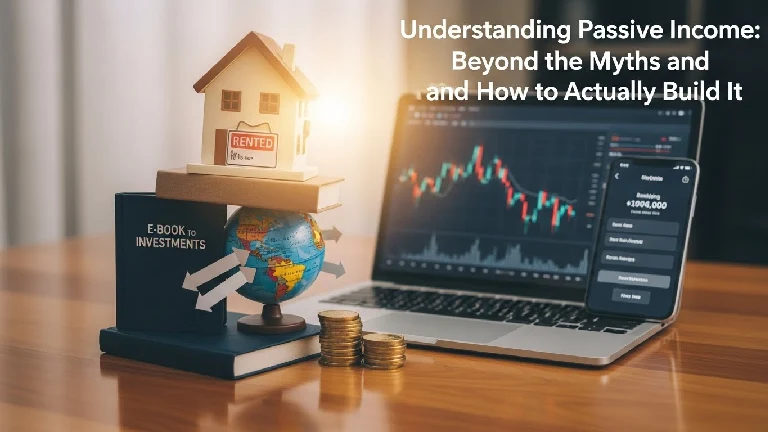
In the digital era of 2025, the phrase “passive income” has become a buzzword plastered across social media, often accompanied by photos of people on beaches with laptops. The promise is alluring: “Make money while you sleep.” However, for many new investors, the reality of passive income is often masked by misleading myths that can lead to costly mistakes.
At The Daley Trade, we believe that true financial freedom comes from understanding the difference between a “get-rich-quick” scheme and a sustainable income stream. To build real wealth, we must look beyond the hype and understand the mechanics of how passive income actually functions in today’s economy.
1. The Greatest Myth: Passive Income is “Effortless”
The most pervasive myth is that passive income requires no work. In reality, every passive income stream requires one of two things upfront: Time or Capital.
- Capital-Intensive: You invest a large sum of money into dividend stocks, real estate, or high-yield savings. The money does the work.
- Time-Intensive: You spend months or years building a digital product, a blog, or a YouTube channel. Your initial “sweat equity” creates the asset that eventually pays off.
2. Myth vs. Reality: Recurring Revenue
Many people mistake “recurring revenue” for passive income. If you are a freelancer with a monthly retainer, that is active income—if you stop doing the work, the check stops coming.
- The Reality: True passive income is decoupled from your time. If you create an automated vending machine business or a digital course that sells via an automated funnel, you are no longer trading hours for dollars.
3. The “Set It and Forget It” Trap
Even the most “passive” assets require maintenance.
- Real Estate: You still need to manage tenants or a property manager.
- Digital Products: Links break, software updates, and content becomes outdated.
- Dividends: Companies can slash dividends during economic downturns, requiring you to rebalance your portfolio.
4. Realistic Passive Income Streams for 2025
If you are looking to start building wealth this year, here are the three most reliable paths that have survived the hype cycle:
High-Yield Savings and CDs
With interest rates remaining higher than in previous decades, putting your emergency fund in a High-Yield Savings Account (HYSA) is the simplest form of passive income. It is low risk and requires zero maintenance.
Low-Cost Index Funds (ETFs)
Rather than picking individual stocks, smart investors trade individual risk for market-wide growth. By investing in an S&P 500 index fund, you are essentially betting on the growth of the top 500 companies in the U.S.
The Rise of AI-Generated Content
In 2025, AI has made it easier to create “leveraged assets.” From automated newsletters to niche informational websites, AI tools allow a single person to manage what used to take a whole team, significantly lowering the “time cost” of building a passive stream.
5. The Tax Implication: What You Keep Matters
A common pitfall for beginners is forgetting that the government takes a cut of “unearned income.”
- Ordinary Income: Most interest and some dividends are taxed at your regular income tax rate.
- Long-Term Capital Gains: If you hold an asset (like a stock) for more than a year before selling, you may qualify for a lower tax rate—a crucial “trade” for long-term wealth building.
Conclusion: The Long Game
Passive income is not a sprint; it’s a marathon. It starts with the discipline to save, the patience to invest, and the wisdom to ignore the “quick win” myths. By building diversified streams today, you aren’t just making money—you’re buying back your future time.